Tofu: The Most Misunderstood Superfood — And Why Veggie Saigon Uses It in 40+ Dishes
Tofu has an image problem. In Western imagination, it's the food of compromise — pale, bland, eaten by people who wish they were eating steak. This image is culturally specific (largely Anglo-American) and historically recent (post-1970s health food movement). In Vietnamese, Chinese, Japanese and Korean cuisines, tofu has been a prized, versatile, beloved ingredient for over 2,000 years. The problem was never the tofu. The problem was always who was cooking it.
At Veggie Saigon, tofu appears in over 40 dishes in at least eight distinct preparations. Each preparation creates a fundamentally different eating experience. Here's the full taxonomy — with nutritional data for each style.
🟡 Style 1: Golden Fried Tofu (Đậu Hũ Chiên Vàng)
Found in: Đậu Hũ Viên Chiên, gỏi cuốn, bún trộn, bánh mì, mẹt cuốn. Method: deep-fried until a golden crust forms while the interior remains silky. Nutrition per standard portion: approximately Protein 14g, Fat 15g, Carbs 28g — 300 kcal. The crust provides textural contrast. The interior absorbs whatever sauce or flavour it's paired with. This is tofu as flavour vehicle — its mildness is the point, not a deficiency.
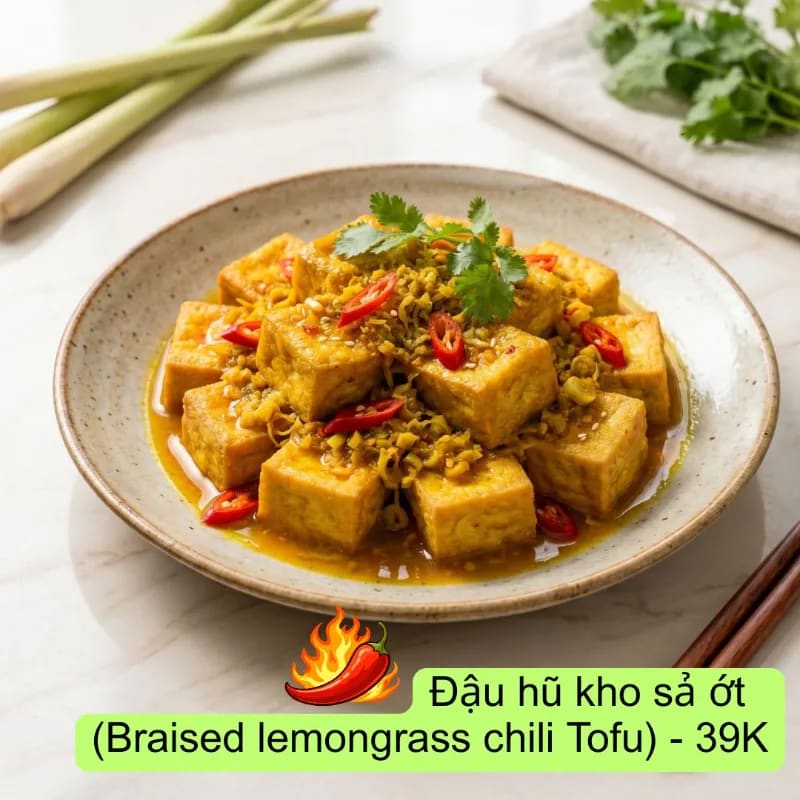
🔴 Style 2: Braised Tofu (Đậu Hũ Kho)
Found in: Đậu Hũ Kho Sả Ớt, Cà Tím Kho Đậu Hũ, Cơm Cà Tím Kho Đậu Hũ. Method: long-braised in a reduction of vegetable stock, soy sauce, lemongrass and chili until the exterior caramelises and the interior becomes deeply flavoured. Nutrition: approximately Protein 14g, Fat 11g, Carbs 11–15g — 185–200 kcal. This is the highest protein-to-calorie ratio of any preparation on the menu. Braised tofu is what converts skeptics — the flavour penetrates to the core, and the texture is complex: slightly yielding on the outside, firm within. The Đậu Hũ Kho Sả Ớt at 195 kcal is perhaps the best illustration of Vietnamese tofu cooking at its peak.
🌊 Style 3: Silken Tofu (Đậu Hũ Mềm)
Found in: Đậu Hũ Mềm Sốt Tứ Xuyên, Đậu Hũ Mềm Sốt Hong Kong. Method: served cold or room temperature, draped in sauce. The tofu is not cooked further — it is delicate, cloud-like, with a texture closer to panna cotta than anything Western diners associate with tofu. Nutrition: approximately Protein 12–13g, Fat 9–12g, Carbs 10–12g — 170–195 kcal. The Sichuan version delivers mala heat against this delicate canvas. The Hong Kong version is refined and gentle — sesame oil, ginger, vegetable oyster sauce. Both are extraordinary demonstrations that tofu's 'blandness' is a cooking problem, not an ingredient problem.
🥊 Style 4: Tofu Balls / Shumai (Đậu Hũ Viên / Xíu Mại)
Found in: Đậu Hũ Viên Chiên, Xíu Mại Chay, Bún Chả Hà Nội Chay. Method: tofu mashed with carrots, seasonings, shaped into balls and either fried or steamed. Nutrition: Protein 14–16g, Fat 9–15g — 300–380 kcal per dish. This preparation transforms tofu into a bouncy, satisfying texture that is genuinely different from all the others. Xíu mại (steamed) is the gentlest, with a texture like tender meatballs. Đậu hũ viên chiên (fried) has the satisfying resistance of something substantial. Both are evidence that plant-based cooking has its own category of textural pleasure — not mimicry of meat, but something original.
🧬 The Nutritional Science of Tofu
Tofu is made from soybeans, which are one of only two plant foods (the other is hemp) to contain all nine essential amino acids in ratios sufficient to meet adult requirements. This makes soy protein — and tofu — a complete protein: equivalent in amino acid profile to animal protein. Per 100g, tofu contains Protein 8g, Calcium 200mg (20% of daily requirement), Iron 1.7mg, Isoflavones 25–40mg.
The isoflavone concern (the idea that soy 'feminises' men or increases cancer risk) has been thoroughly debunked. The evidence consensus is: isoflavones are phytoestrogens that bind to oestrogen receptors with 1/1000th the potency of human oestrogen — a completely negligible hormonal effect. Multiple large studies have found no association between moderate soy consumption and any cancer type. Japanese and Chinese populations consume tofu daily for decades — the populations with the lowest rates of hormonal cancers in the world.
At Veggie Saigon, tofu is not a compromise. It is a 2,000-year-old ingredient being cooked with intelligence, creativity and full nutritional transparency. That is not compromise. That is craft.
Open daily 10:00–21:00 · 76 Thủ Khoa Huân, Sơn Trà, Da Nang