The Five Pungent Roots: The Aspect of Vietnamese Buddhist Vegan Cooking Most Travelers Never Discover
🧄 Among the many surprises that await travelers who engage seriously with Vietnamese Buddhist food culture, one is almost universally unexpected: in strict Buddhist vegetarian practice, the prohibition extends beyond animals to a specific set of five plant ingredients. These five — garlic, onion, leek, scallion, and chive — are known as the ngũ vị tân, the "five pungent roots," and their exclusion from the strictest forms of Vietnamese Buddhist cooking is as theologically significant as the exclusion of meat.
For international travelers accustomed to thinking of veganism in terms of animal products only, this dimension of Vietnamese vegan culture opens a new conceptual door — one that reveals how food and spirituality are more deeply entangled in Vietnamese Buddhist thought than any simple dietary checklist can capture.
📖 The Theological Foundation
The exclusion of pungent roots in Buddhist vegetarianism derives primarily from the Śūraṅgama Sūtra (Kinh Thủ Lăng Nghiêm), one of the most important texts in Chinese and Vietnamese Mahayana Buddhism. The relevant passage teaches that pungent plants, when eaten cooked, increase desire and passion; and when eaten raw, increase anger and aggression. Because Buddhist practice aims at the cultivation of equanimity, clarity, and compassion — and the reduction of desire, aversion, and delusion — consuming substances that agitate these mental qualities is considered counterproductive to spiritual development.
The five pungent plants identified in various Buddhist texts are:
1. Garlic (tỏi): The most potent and most strictly excluded. Garlic's sulfurous compounds — the same chemicals responsible for its distinctive aroma — are considered the most agitating of the five. In many Vietnamese Buddhist monasteries, even the smell of garlic being cooked in a neighboring building is considered a disturbance to meditation.
2. Onion (hành tây): The large-bulb onion used extensively in Western and Vietnamese mainstream cooking. Excluded in strict Buddhist vegetarianism.
3. Leek (tỏi tây): The milder European allium, less common in Vietnamese cooking but included in the prohibition.
4. Scallion / Green Onion (hành lá): One of the most ubiquitous ingredients in Vietnamese cooking — a garnish on pho, a component of almost every savory preparation. Its exclusion from strict Buddhist cooking is one of the most practically significant aspects of the tradition.
5. Chive (hẹ): Used in dumplings, stir-fries, and various preparations. Also excluded.
Together, these five belong to the allium family — the same botanical genus as garlic and onions. Their shared characteristic, from a Buddhist theological perspective, is the quality of stimulating rather than calming mental states. From a modern pharmacological perspective, they share the characteristic of containing sulfur compounds that have measurable neurological and physiological effects on the human body.
🔬 The Science Behind the Theology
The Buddhist theological claim — that pungent roots agitate the mind — turns out to have a basis in contemporary nutrition science, though the mechanisms are different from what the classical texts describe.
Allium compounds (primarily organosulfur compounds like allicin in garlic and quercetin in onions) do have documented physiological effects: vasodilation, anti-inflammatory action, effects on gut microbiome composition, and documented influences on neural signaling pathways. Whether these effects translate into the specific mental qualities of increased desire and anger as described in the Buddhist texts is not established by clinical research — but the basic observation that these compounds have measurable physiological and neurological effects is not in dispute.
More relevant to contemporary readers may be the observation that strict dietary discipline of any kind — whether the Buddhist prohibition on pungent roots or the more general discipline of mindful eating — has documented psychological benefits independent of the specific content of the restriction. The practice of careful attention to what one eats, and why, and what effects it has, produces a quality of relationship with food that is itself psychologically beneficial.
🍽️ What This Means in the Kitchen
The practical cooking implications of excluding the five pungent roots are profound — and, once understood, reveal why Vietnamese Buddhist temple cooking has developed such extraordinary depth of flavor through other means.
When garlic, onion, and scallion are removed from the vegetarian cook's toolkit, a creative challenge emerges: how do you build aromatic depth, savory complexity, and satisfying flavor without the most basic flavor-building ingredients of almost every food culture on Earth?
Vietnamese Buddhist temple chefs have spent centuries solving this problem. Their solutions:
Mushrooms (nấm): The primary umami source in Buddhist temple cooking. Dried shiitake mushrooms provide glutamates that parallel the depth onion and garlic contribute in mainstream cooking. Mushroom-based stocks replace allium-based stocks as the foundation of flavor.
Ginger (gừng): Not excluded from Buddhist cooking, ginger provides the aromatic pungency and heat that partially substitutes for garlic and onion in certain preparations.
Fermented soy products (tương, đậu hũ nước): Fermented bean paste and soy sauce provide umami, saltiness, and fermented complexity that help compensate for the missing allium depth.
Star anise, cinnamon, and five-spice: Aromatic spices that build complexity in braised dishes and stocks without pungent roots.
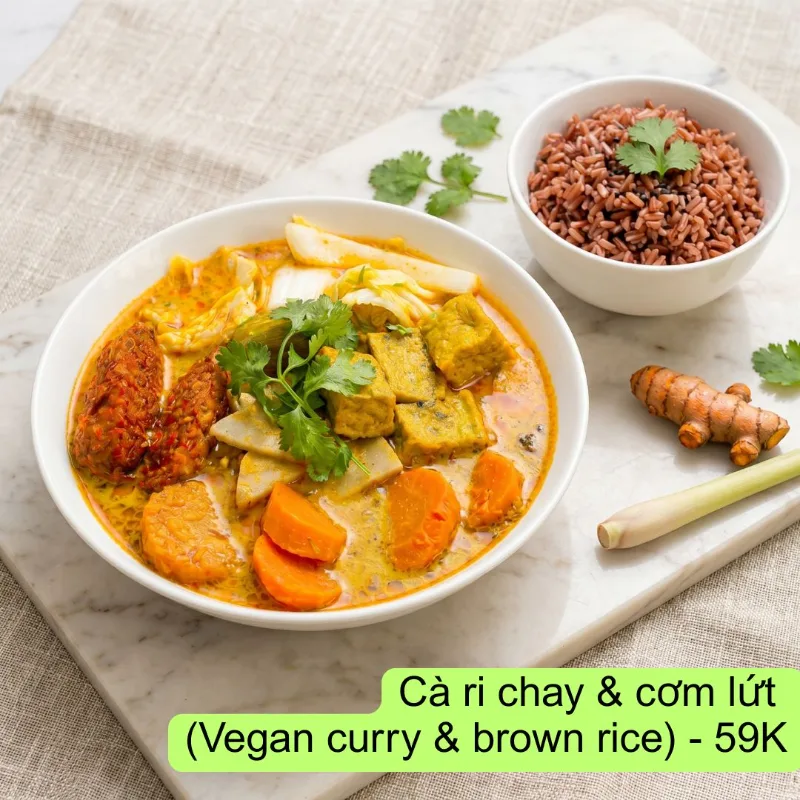
Lemongrass, galangal, kaffir lime leaves: Citrusy and floral aromatics that replace onion-family aromatics with a completely different but equally complex flavor profile.
The result is a cooking style that is, in some ways, more technically demanding than mainstream Vietnamese cooking — because it requires building equivalent flavor complexity from a more restricted ingredient set. The great dishes of Vietnamese Buddhist temple cooking are not simple. They are masterclasses in the art of flavor without alliums.
🌍 How This Surprises International Travelers
International travelers — including experienced vegans — typically encounter two surprises when they learn about the pungent root prohibition:
Surprise 1: That a food tradition described as "vegetarian" or "vegan" would exclude plant ingredients at all. The Western vegan framework is defined almost exclusively by what is excluded from the animal kingdom. The Buddhist vegan framework adds a second category of exclusion — plant substances considered spiritually counterproductive. This is a genuinely different philosophical approach to food.
Surprise 2: That food made without garlic and onion can be as flavorful as it is. Many people find it difficult to imagine deeply satisfying savory food without these foundational aromatics. Vietnamese Buddhist temple cooking demolishes this assumption. The mushroom-ginger-spice-ferment axis of flavor is not a compromise or a substitution. It is its own complete, sophisticated, and extraordinarily delicious flavor system.
✅ Veggie Saigon's Approach
Veggie Saigon Da Nang does not enforce the pungent root prohibition in our standard menu — we use scallions as garnishes and aromatics in some preparations, making us more accessible to the full range of international vegan customers, including those for whom avoiding garlic and onion would be unexpected and potentially off-putting.
However, we deeply understand and respect the tradition of the ngũ vị tân restriction. Customers who observe strict Buddhist vegetarianism and wish to avoid all five pungent roots can inform our kitchen team, who will prepare accommodations. We have the knowledge, the ingredients, and the philosophical alignment to honor this request.
More broadly, the ngũ vị tân tradition informs our cooking philosophy in the way that good philosophy always should — not as a rigid rule to be mechanically applied, but as a source of insight about the relationship between what we eat and how we think, feel, and exist in the world. The Buddhist kitchen teaches us that food is not neutral. Every ingredient has effects. Choosing carefully is a practice, not just a dietary decision.
🧄 The five pungent roots are the most surprising element of Vietnamese Buddhist vegan culture for international travelers — and one of the most intellectually interesting. They reveal a food philosophy that is not just about avoiding harm to animals, but about the relationship between food, mind, and spiritual cultivation. Understanding them deepens the appreciation of every meal eaten in the Vietnamese Buddhist vegan tradition.